


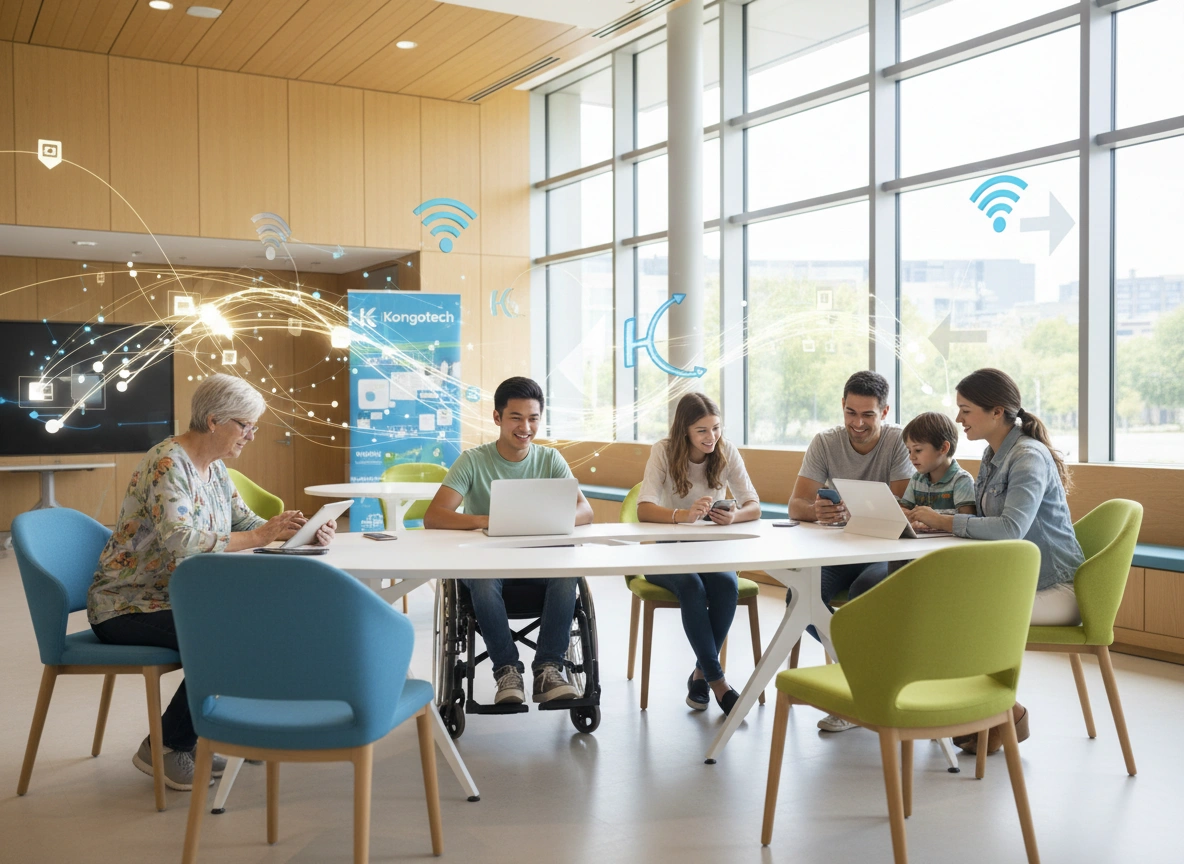
Technology serves as the great equalizer of our time, yet millions remain on the sidelines due to cost, complexity, or physical limitations. For decades, the tech industry focused heavily on “early adopters” and “power users,” often leaving behind those who needed digital tools the most. However, a shift is happening. Companies are beginning to realize that true innovation isn’t just about speed or processing power—it’s about inclusivity.
Leading this charge is Kongotech, a technology firm that has made accessibility the cornerstone of its corporate strategy. By redesigning hardware, simplifying software interfaces, and launching community-driven initiatives, Kongotech is actively dismantling the barriers that keep people offline. This article explores the specific strategies and innovations Kongotech employs to ensure the digital future is open to everyone.
Redefining Hardware for Physical Accessibility
The most immediate barrier to technology access is often the device itself. Standard keyboards, mice, and touchscreens assume a level of fine motor control and visual acuity that not everyone possesses. Kongotech tackled this challenge by launching its “Adaptive Tech” line, a suite of hardware designed with universal design principles at the forefront.
The K-Touch Interface
One of their flagship innovations is the K-Touch Interface. Traditional touchscreens rely on precise tapping and swiping. For users with tremors or limited mobility, these actions can be frustrating or impossible. The K-Touch uses pressure-sensitive technology combined with predictive AI. It distinguishes between an intentional selection and an accidental brush against the screen. Users can customize the sensitivity levels and touch duration required to register a click, allowing individuals with conditions like Parkinson’s disease to navigate tablets and smartphones with confidence.
Voice-First Peripherals
While voice assistants are common, Kongotech integrated voice control directly into the hardware layer of their new laptop series. This means users can boot up, navigate the BIOS, and perform system recovery tasks entirely through voice commands—areas of computing that were previously inaccessible to blind or visually impaired users without sighted assistance. By embedding screen readers at the firmware level, Kongotech ensures that a user’s independence starts the moment they press the power button.
Bridging the Economic Digital Divide
Accessibility isn’t just about physical capability; it is also about affordability. High-performance technology often comes with a prohibitive price tag, creating a digital divide that disproportionately affects low-income communities. Kongotech addresses this through a two-pronged approach: modular upgrades and subsidized access programs.
Modular “Forever” Devices
Electronic waste is a global crisis, and the cycle of planned obsolescence forces consumers to buy new devices every few years. Kongotech introduced the “Core-M” framework, a modular laptop design where key components—like the processor, RAM, and battery—can be swapped out easily without tools.
This design philosophy drastically reduces the long-term cost of ownership. Instead of buying a new $800 laptop, a user can upgrade their processor for $150. This makes high-quality computing financially accessible to students and families who cannot afford frequent replacements. It also empowers users to repair their own devices, demystifying the technology they use daily.
The “Connect 1 Million” Initiative
Beyond hardware design, Kongotech launched the “Connect 1 Million” partnership with local governments and NGOs. This program provides refurbished Kongotech devices to underserved schools and community centers. Unlike typical donation dumps, this program includes three years of free technical support and high-speed internet subsidies.
In a recent case study from a rural district in Ohio, the initiative provided 500 households with internet-enabled devices. The impact was immediate: student participation in remote learning increased by 40%, and adult employment rates improved as parents gained the ability to apply for jobs online.
Software That Speaks Everyone’s Language
Even with the right hardware, software complexity can alienate users. Interfaces are often cluttered, settings are buried in sub-menus, and language support is frequently limited to major global dialects. Kongotech’s software division focuses on cognitive accessibility and linguistic inclusivity.
The “Clarity” Operating System Overlay
To help seniors and digital novices, Kongotech developed “Clarity.” This is an optional operating system overlay that simplifies the user interface. It strips away non-essential icons, enlarges text, and uses high-contrast visuals.
What makes Clarity unique is its “Guided workflows.” Instead of presenting a blank desktop, Clarity asks, “What would you like to do?” and offers options like “Call a friend,” “Read the news,” or “View photos.” This task-oriented approach lowers the cognitive load for users who find traditional operating systems overwhelming. It has become a favorite feature for senior living facilities that deploy Kongotech tablets to residents.
Native Translation Engines
Language barriers prevent millions from accessing the full potential of the internet. Most translation tools require an active internet connection, which isn’t always available in remote regions. Kongotech integrated a neural machine translation engine directly onto the chips of their budget smartphones.
This allows for real-time, offline translation of text and speech in over 80 regional dialects, not just major languages. For a small business owner in a remote part of Southeast Asia, this means they can communicate with suppliers or customers who speak a different dialect without needing expensive data plans or reliable Wi-Fi.
Empowering Developers to Build Accessibly
Kongotech recognizes that they cannot build an accessible digital world alone. They need the entire developer ecosystem to prioritize inclusivity. To facilitate this, they released the “Kongotech Accessibility SDK” (Software Development Kit) as an open-source tool.
Automated Accessibility Testing
The SDK includes tools that automatically scan code for accessibility violations during the development process. It flags issues like low contrast ratios, missing alt-text for images, or buttons that are too small for touch targets. By integrating these checks into the standard workflow, Kongotech makes it easier for developers to build accessible apps by default, rather than treating accessibility as an afterthought.
The Inclusive Design Grant
To incentivize innovation, Kongotech established an annual grant program awarding $5 million to startups that are solving specific accessibility challenges. One recent recipient used the funds to develop a headset that allows users with quadriplegia to control a mouse cursor using only eye movements and subtle head gestures. By funding these niche innovations, Kongotech acts as an incubator for the next generation of assistive technology.
Fostering a Culture of Inclusion
Technology is ultimately a reflection of the people who build it. Kongotech understands that to build products for everyone, their workforce must represent everyone. The company overhauled its hiring practices to actively recruit individuals with disabilities.
Their “Neurodiverse Talent Program” specifically recruits individuals on the autism spectrum for roles in quality assurance and data analysis—fields where attention to detail and pattern recognition are immense assets. They also redesigned their physical and digital workspaces to be fully accessible, ensuring that employees with disabilities have the same opportunities for career advancement as their peers.
Internal hackathons are held quarterly with a strict rule: every prototype must be usable by a person with a disability. This constraint breeds creativity. Engineers who have never considered how a blind person uses a smartphone are suddenly forced to rethink basic interaction models. This cultural shift ensures that empathy is engineered into every product Kongotech ships.
The Road Ahead
The journey toward total digital inclusion is far from over. As technologies like Virtual Reality (VR) and Augmented Reality (AR) gain traction, new barriers will emerge. Kongotech is already researching how to make immersive 3D environments accessible to those with visual or vestibular impairments.
They are currently testing haptic feedback suits that allow deaf users to “feel” sound in virtual environments, providing cues that are usually auditory. They are also working on simplified AR interfaces that can assist people with cognitive impairments in navigating public transit systems by overlaying clear, simple arrows on the real world.
Conclusion
Kongotech proves that accessibility is not a niche market or a compliance checklist—it is an engine for innovation. By rethinking hardware for physical needs, lowering economic barriers through modular design, and simplifying software for cognitive ease, they are setting a new standard for the industry.
When technology is designed with the margins in mind, it works better for everyone. A voice command feature designed for a blind user helps a busy parent cooking dinner. A high-contrast screen designed for low vision helps a commuter reading in bright sunlight. Kongotech’s commitment to making technology more accessible is not just an act of corporate social responsibility; it is a strategic vision that ensures the digital revolution leaves no one behind.
Please visit this website for more info.
